
History of the Workers' Movement: How Did NYC Get 200,000 Public Apartments?
Em Smith
The U.S. today has fewer than one million public housing units. Public housing has been defunded, dismantled, and neglected all around the country. In most places, it makes up a fraction of 1 percent of all rental units.
But in New York City, nearly 10 percent of all rental units are publicly owned. New York City has more than 177,000 publicly-owned units, which house more than 500,000 people. This means that nearly 20 percent of ALL public housing units in the U.S. are in New York City.
Wall Street, corporate landlords, and the capitalist class have done their best to undermine New York’s public housing. But for all their attacks, they haven’t been able to destroy what the housing movement has won over the last 100 years
So how did NYC get so much fucking public housing?
RENT STRIKES, RENT STRIKES, RENT STRIKES!
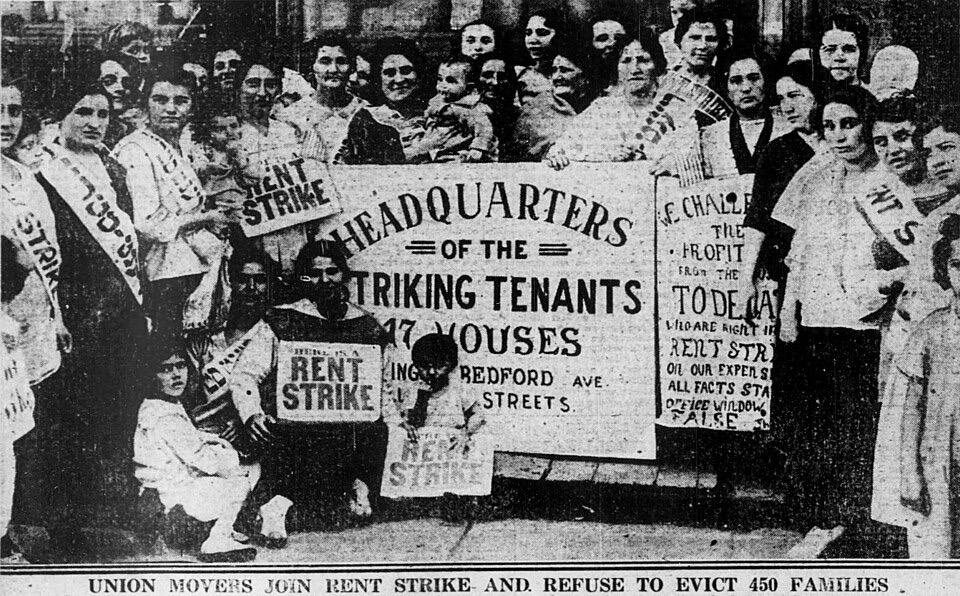
The first major rent strike anywhere in the U.S. happened in New York City in 1904. It was led by Jewish immigrant women and involved more than 2,000 families. The landlords on the Lower East side had threatened to raise rents by 20-30 percent. Tenants got organized, withheld their rent, and forced the landlords to back down.
But the victory was short lived. The next year, landlords raised the rents again. Workers and the unemployed were squeezed, creating an explosive situation. An economic depression in 1907 lit the fuse.
In December, 10,000 families refused to pay the rent. The rent strike spread throughout Manhattan and Brooklyn. Once again, Jewish immigrant women led the way, drawing on their experience with the boycotts and labor strikes of recent years.
The rent strikers were militant. They hung effigies of their landlords from windows, and the red socialist flag became a symbol of the strike. They raised a demand to cap rent at 30 percent of income.
The 1908 strike lasted for only two weeks. It was broken by police violence and the mass handing-out of eviction notices by the landlords. But the rent increases were rescinded for 2,000 families, and the struggle set the stage for a much bigger victory 10 years later.
Socialists Lead; Sectarians Scold
Socialists dominated the leadership of the NYC renters’ movement, beginning with the first strike in 1904. In 1908, the Socialist Party of America formally led the strike.
But some socialist organizations took a sectarian approach (as usual). The Socialist Labor Party called the 1908 rent strike “laughable, were it not so sad.” They scolded renters and other socialists, saying they should go organize a factory instead! “If this stupendous amount of energy had but been utilized to organize the workingmen as producers, not as tenants, to fight their battles on the field of industry, and to improve their conditions generally, how much good could have been accomplished? He who thinks that a rent strike is a Socialistic tenet is greatly mistaken.”
Principled socialists ignored the snobbery of the SLP, and joined the real movement. This included 16-year-old Pauline Newman, a socialist worker at the Triangle Shirtwaist Factory and a key organizer of the 1908 rent strike.
Scaring the Landlords
Things came to a head after World War I. The war created a new crisis for renters. Housing construction had slowed to a crawl, as industry was redirected to war production. At the same time, thousands of workers had moved to the city to get jobs in the military production factories. A shortage of coal in 1918 broke the backs of working families. They already couldn’t afford the rent, and now they couldn’t heat their homes.
Between 1918 and 1920, hundreds of thousands of New Yorkers participated in a historic wave of rent strikes.
The ruling class panicked. They had just seen workers overthrow capitalism in Russia, and the Bolsheviks take power. New York landlords worried that they were next.
Stewart Browne, president of the Real Estate Owners Association, warned landlords in 1919, a year into the strike wave: “There are probably 200,000 potential anarchists in the City only waiting a favorable opportunity to raise the flag of Soviet government, and their leaders are utilizing the rent and housing situation to accentuate the discontent....It therefore behooves every landlord and every realty organization to 'go easy' on 'rent increases' during the coming winter.”
The capitalists and politicians responded with a combination of concessions and repression. They banned red flags from being displayed in windows and issued eviction notices en masse. In April 1920, five Socialist Party representatives were expelled by the New York State Assembly. But six months later, the New York Assembly was forced to pass the Emergency Rent Laws, the first rent control law in U.S. history.
They Did It in Russia!
None of this solved this problem, of course. When the Great Depression hit in 1929, masses of workers were out of a job. Once again, they couldn’t afford the rent.
The rent strikes began again in 1931. This time, the strikes were led by the Communist Party and their Unemployed Councils.
The Trotskyist party in New York, the Communist League of America, was bafflingly silent about the rent strikes throughout 1931-1933. They published only one short article about them in a two-year span. The Communist Party, on the other hand, was explaining to tenants that the socialist revolution in Russia had achieved what capitalism could not: it made housing affordable.
In October 1931, the Communist Daily Worker ran an article describing the housing situation in the USSR: “Rents are graduated … the lower the income and the greater the number of dependents, the lower the rent. In many industrial enterprises workers receive housing, light, and fuel free .... Even where rents are paid, they constitute but a small portion of the total family expenditures. Thus, in 1929-30, the average rent paid by workers' families amounted to only 6.4 per cent of the total expenditures.”
By contrast, in New York City in 1932, rent was eating up 30 percent of workers’ income on average (not much different than today).
For the capitalist class of New York, the threat of rent strikes was now paired with a serious political threat. In the 1932 mayoral election, the socialist and communist candidates together received nearly 300,000 votes, about 14 percent of the total. In 1934, there were 5,500 members of the Communist Party in New York; by 1937, membership had tripled to nearly 17,000.
Something had to be done. So the capitalists called in Zohran Mamdani’s “favorite mayor,” Republican Fiorello La Guardia.
La Guardia won the mayoral election in 1933, on a platform of sweeping reforms. He immediately got to work to cut the knees out from the movement (with a smile). In January 1934, the state assembly passed a bill allowing cities to create public housing agencies. Just one month later, La Guardia established the New York City Housing Authority (NYCHA).
In its first five years, the NYCHA built 12,000 housing units. It built another 25,000 in the 1940s, and 70,000 in the 1950s.
Like with every victory under capitalism, the NYCHA wasn’t given out of the goodness of La Guardia’s heart. It was a concession forced from him by the working class.
But today, these victories are under attack, and housing is as expensive as ever. We need to return to the roots of what won public housing in the first place: revolutionary leadership, organization, and an all-out fight against the landlords.