
Do We Need Rent Control?
Gwendolyn Hart
Workers everywhere are being crushed by the cost of living crisis, and there is no bigger culprit than the skyrocketing cost of rent.
Over the past five years, rent costs have increased three times faster than inflation. Half of all renters in the US are now rent-burdened, paying at least 30% of their income on rent – this is the highest that figure has ever been in US history. 39% of Americans report skipping meals in order to afford housing payments. There has been a rash of recent evictions, with landlords targeting one in every thirteen renter households for eviction in 2025.
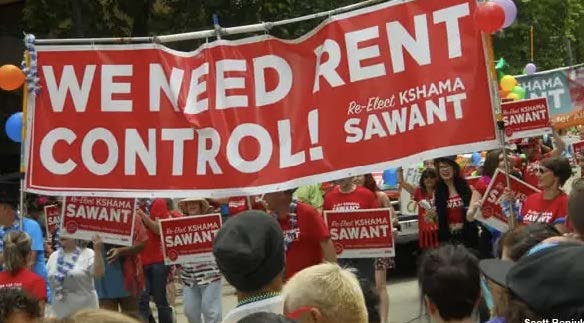
The rent is too damn high! That’s why there are people everywhere who are talking about the need for rent control. Freezing the rent on rent-stabilized apartments is one of the core demands that catapulted Zohran Mamdani’s mayoral campaign to prominence in New York City. But there is also a vicious propaganda campaign against rent control, claiming that it actually harms access to affordable housing. The landlord lobby has weaponized this fear campaign to ban rent control in 37 states.
Is there truth to these claims? Is rent control good or bad for workers?
One of the most rampant fears among workers is that “Rent control traps people in their homes.” But this myth is rooted in landlord lies.
After rent control passed in NYC, landlords and capitalist politicians passed a “vacancy decontrol” loophole in the law. This means once someone moves out of a rent-controlled apartment that unit becomes immediately decontrolled, and either becomes “rent stabilized” (a second-rate “soft” version of rent regulation) or directly returns to market prices. Originally there were 2 million rent-controlled units in NYC, but today that number has fallen to under 20,000.
People are “trapped” in their rent-controlled apartments only because they can’t afford to move out. If they do they will get immediately tossed into the jungle of market-rate housing and likely driven out of the city.
That’s not a failure of too much rent control. That is a failure of there not being nearly enough rent control.
Another popular narrative says that rent control will stop new construction from being built. This is justified with middle-school arguments about supply and demand. If landlords aren’t allowed to price-gouge their tenants as much as they want then what’s the financial incentive for developers to increase the housing supply?
The reality is rent control is no barrier to new construction. New York City’s biggest housing boom was in the post-war era when rent control was at its strictest, averaging 40-60 thousand new housing permits annually in the 1960s. Cities in the Bay Area with rent control built more new units per capita in the early 2000s than cities without rent control.
We need to be prepared to counter the lies of the landlord lobby. We also need to answer their threats with an offensive approach, calling for a mass expansion of affordable public housing alongside strong rent control. Workers should say to the developers: you won’t build new housing? Don’t worry, we will.
There are all kinds of housing horror stories that get blamed on rent control, and United Front members have heard nearly all of them. Someone once told us rent control was to blame for the South Bronx Fires, when landlords burned down their buildings for insurance money. In reality, these were attacks motivated by racial hatred against the black and brown tenants; the most infamous case was landlord Imre Oberlander who tried to burn down one of his apartment complexes while wearing blackface.
There is an enormous mass of propaganda against rent control, because the lack of it means working people are left dealing with the consequences of unchecked landlord greed. When the minimum wage is increased, landlords respond rapidly by raising the price of rent. The more properties a landlord owns, the more likely they are to raise rent. In 2022, corporate landlords were exposed for using RealPage software to coordinate a cartel to maximize rent increases across entire cities, including Seattle.
“In one neighborhood [Belltown] in Seattle, ProPublica found, 70% of apartments were overseen by just 10 property managers, every single one of which used pricing software sold by RealPage.”
There are no agnostic “free market” dynamics that just so happen to be organically causing high rent increases. The only choice is between a profit-maximising, price-fixing scheme driven by the greed of big corporate landlords like Greystar or price-fixing decided by workers getting organized so we can afford to live.