
Labor Leadership Abandons Striking Hotel Workers
Summer Miller
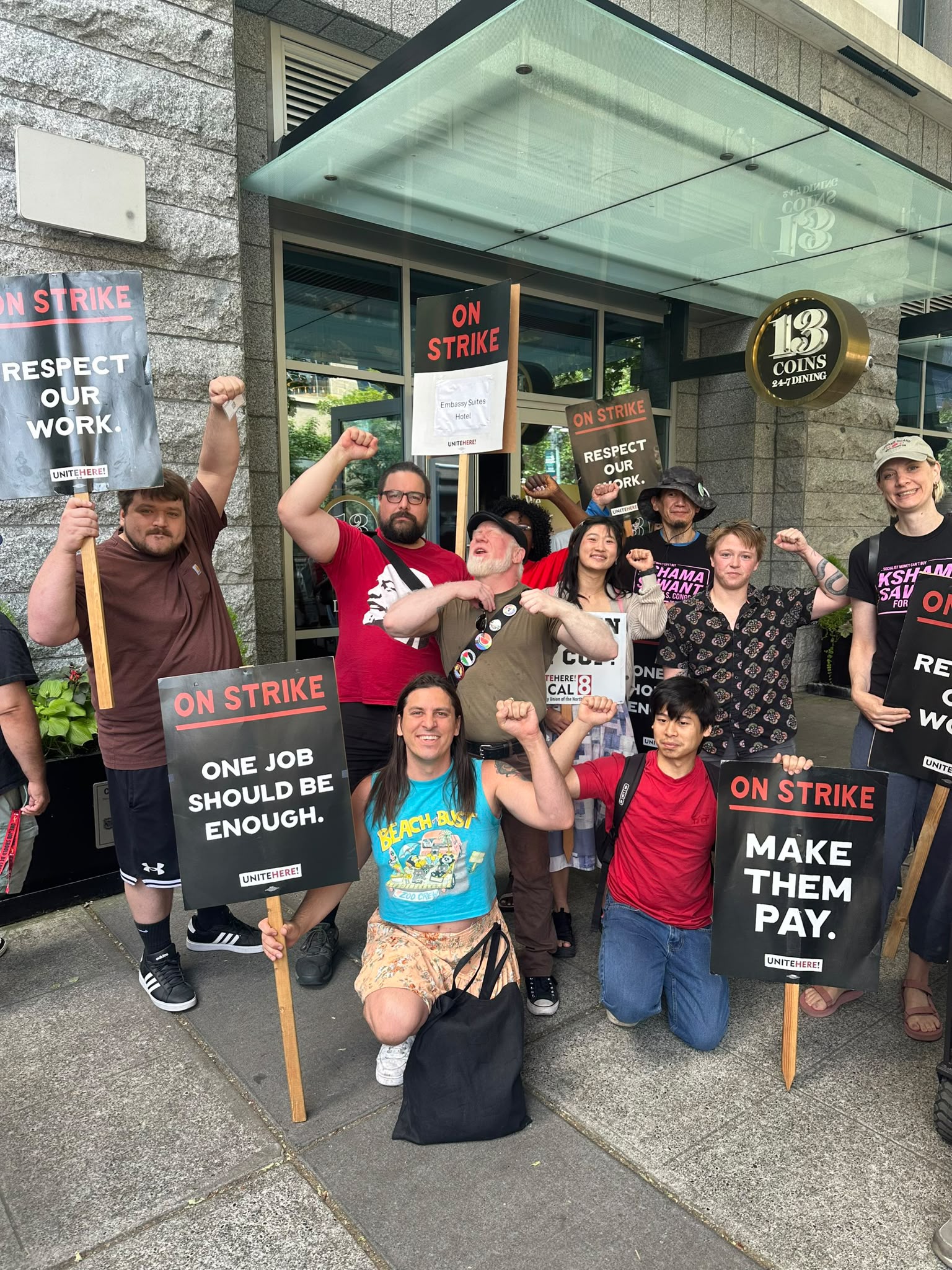
Seattle’s labor movement has tens of thousands of organized workers and only one active strike to support, yet labor leaders have left 117 hotel workers to fight Hilton largely alone.
The workers at Embassy Suites have been on strike since June 18. They are entering their fourth week demanding a $6-an-hour raise over two years, guaranteed year-round healthcare, safe staffing, and the right to refuse work when ICE agents enter the hotel.
Before workers walked out, Hilton, which made $3B in profit over the last two years, was proposing $1 an hour or less each year over FIVE years. This wouldn’t even keep up with inflation.
On June 29, two weeks into the strike, Hilton attempted to buy an end to the strike with an immediate 40-cent raise if workers stopped picketing and returned to work. Workers rejected the offer and voted to remain on strike.
This should have triggered immediate escalation. Instead, UNITE HERE Local 8 cut the picket times from 6 a.m.–6 p.m. to 7 a.m.–noon. Hilton tried to break the strike for 40 cents, and Local 8 rewarded the company with seven fewer hours of picketing each day.
Early in the strike, UFWP members had proposed establishing 24-hour pickets. Several workers agreed, but Local 8 staff answered that they couldn’t have 24-hour pickets because there was a noise ordinance.
Ordinance, schmordinance! Local 8 should have announced 24-hour pickets and forced the city to choose sides. If Mayor Katie Wilson or Democratic officials tried to enforce the ordinance against striking workers, the unions should have announced that they would organize to vote them out of office.
UNITE HERE Local 8 represents more than 3,000 hospitality workers across the greater Seattle area. It has paid staff, organizers, and relationships throughout the labor movement. It could have mobilized delegations from every workplace it represents, raised a serious strike fund, and demanded mass support from every major union. Instead, Local 8 leaders offered nothing but excuses.
The timing for this strike could hardly have been more favorable. The World Cup created high hotel demand. Embassy Suites is right next to the stadiums. Major match days created opportunities for large, loud pickets, mass labor mobilizations, and serious disruption to big-business-as-usual for Hilton. But labor leaders let this leverage slip away.
During the final U.S.–Belgium match on Monday, July 6, there were around 40 people at the picket’s peak. Eight had been mobilized by the United Front for a Workers’ Party. SEA, IAM, AFSCME, SPEEA, and other major unions had one or two members there at most.
Union members cannot attend mobilizations they are never seriously called into. Labor councils and union officers have email lists, steward structures, social media accounts, staff, meeting agendas, and political relationships. They could organize union contingents, adopt-a-shift programs, buses, workplace delegations, fundraising, and mass turnouts on match days.
MLK Labor boasts that it represents more than 225,000 workers and 150 unions in King County. It did not even deploy its own staff to help build the picket. It called for no emergency labor meeting. It coordinated no mobilization through its affiliated unions.
One worker from every affiliated union would have put more than 150 people on the line. One-tenth of one percent of the workers MLK Labor represents would have produced 225.
Seattle does not lack union members. It lacks a labor leadership prepared to mobilize them into a serious class fight.
During the first week, Workers were energetic and discussing potential tactics for escalation. Now turnout has fallen and picket lines are often sad.
The decline in morale is not proof that workers were unwilling to fight. It is the predictable result of asking a small group of workers to maintain an open-ended strike while the resources of the wider labor movement remain largely unused.
UFWP has regularly mobilized supporters. When we do, we often make up a majority (or all) of the outside support.
Local 8 Secretary-Treasurer Stefan Moritz defended the failure to mobilize broader support by telling a UFWP member that “this is just what’s possible” and “the workers are doing their best.”
The workers are doing their best. The leadership is not.
Kshama Sawant, the independent socialist running for Congress, also failed the test of this strike. Kshama's campaign deserves some credit for mobilizing supporters during the first week of the strike, but those mobilizations stopped, and the campaign has raised no criticism of Local 8's leadership and has made no attempt to inject a more militant strategy into the strike.
This doesn’t change the fact that workers should support Kshama over her opponent Adam Smith. There is no excuse for labor leaders to endorse Smith, who is a capitalist politician and an open strikebreaker. But “revolutionary” socialists, which Kshama claims to be, must be judged by whether they help develop working-class struggle, not simply by whether they show up for a solidarity photo op on the picket line.
This is exactly why Marxists have to organize inside the labor movement. Workers need to organize themselves, fight for democratic control over their own unions, openly argue over strategy, and reject the idea that officials always know best. If leaders refuse to organize the kind of fight needed to win, workers should organize to force a different course—and replace leaders who stand in the way.
We need leadership in the labor movement that is prepared to shut down workplaces, not one that makes sure the picket ends before Hilton’s dinner rush.